
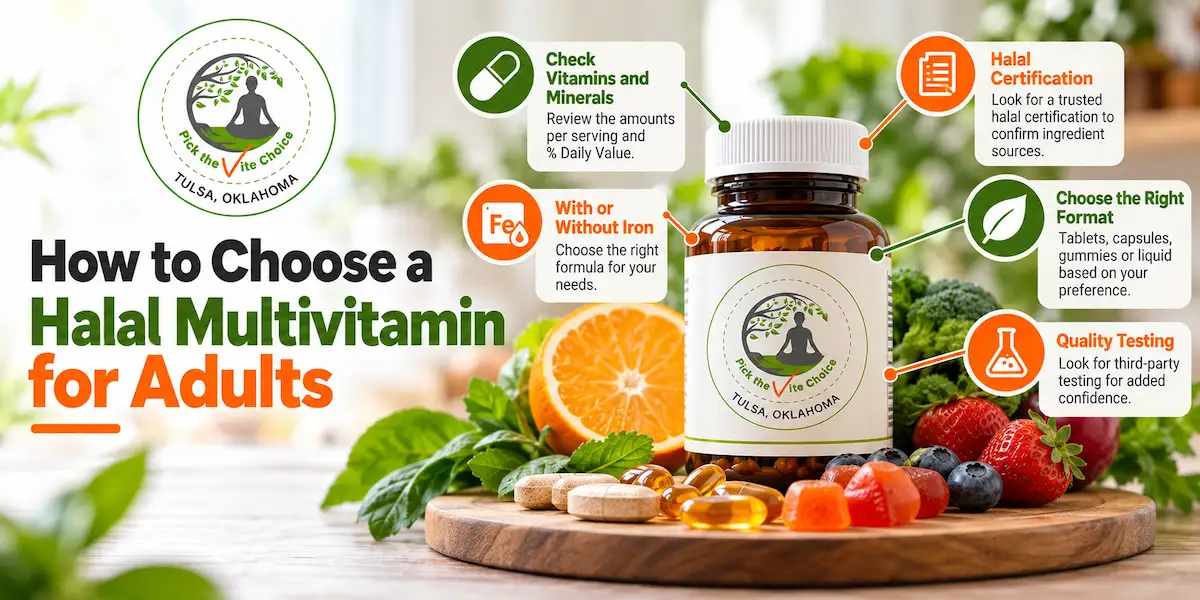
Choosing a halal multivitamin for adults involves more than finding a halal logo on the bottle. You also need to check which vitamins and minerals are included, how much you get per serving, whether the formula contains iron, the type of capsule or gummy used, and whether there is meaningful quality testing behind the product.
There is no standard formula that every multivitamin must follow. Manufacturers choose which nutrients to include and in what amounts, so two adult multivitamins can have very different Supplement Facts panels. The right choice should match your age, diet, life stage, health needs, and dietary requirements.
Here is what to compare before buying halal vitamins for adults.
Start with the Supplement Facts panel rather than the claims on the front of the bottle.
Look at the serving size, individual vitamins and minerals, amounts per serving, and Percent Daily Value.
A basic adult multivitamin commonly provides a range of vitamins and minerals close to established Daily Values. Other formulas contain much higher amounts of selected nutrients or include additional ingredients such as herbs.
NIH notes that multivitamins can help increase nutrient intake when a person’s diet does not provide enough, but they can also increase the risk of getting excessive amounts of certain nutrients when combined with food and other supplements.
When comparing halal daily vitamins, ask whether the formula fills a realistic nutritional need rather than simply containing the longest ingredient list.
Once you know the serving size, review the nutrient amounts. Common multivitamin ingredients may include vitamins A, C, D, E, several B vitamins, folate, biotin, iodine, zinc, and other minerals.
Pay attention to the % Daily Value.
This tells you how much one serving contributes toward the established Daily Value for that nutrient.
Do not assume that a formula containing 500% of a Daily Value is automatically better than one containing 100%. Your nutritional requirements depend on factors such as age, sex, diet, pregnancy, and health status.
Iron is one of the most important differences between adult multivitamins. Not every adult needs the same amount.
For adults ages 19 to 50, the NIH recommended dietary allowance is 8 mg per day for men and 18 mg per day for women. Adults age 51 and older generally have a recommended intake of 8 mg per day. Pregnancy increases the recommended amount to 27 mg per day.
A halal multivitamin with iron may make sense for someone whose dietary intake or life stage creates a greater iron requirement. But iron is not an ingredient to choose simply because it appears to make a formula more complete.
If you have been told you have iron deficiency, anemia, iron overload, or another condition affecting iron status, discuss supplementation with a healthcare professional rather than relying on a general multivitamin.
ViteChoice currently lists both an Adult Advanced Multi-Vitamin/Mineral Complex and a Liquid Multi-Complete with Iron, giving shoppers different formulation options to compare.
The best format is the one you can take consistently and that provides the nutrients you are looking for.
Tablets can hold a broad mix of vitamins and minerals in a compact form. They may be less convenient for people who dislike swallowing larger pills.
Capsules can be easier for some people to swallow and may use vegetable-based shells. However, capsule material still needs to be checked when halal compliance matters.
Gummies are easy to chew and may be more convenient for adults who dislike pills. Check the serving size, added sugars, and complete nutrient profile rather than assuming a gummy contains the same nutrients as a tablet.
Liquid-filled capsules or softgels are often used for ingredients that work well in oils. The shell may contain gelatin or other ingredients whose source should be verified for halal compliance.
Format does not tell you whether a product is high quality or halal.
Read the ingredient list and certification information for the specific product.
For example, ViteChoice’s Adult Advanced Multi-Vitamin/Mineral Complex is currently sold as a gummy formula, with a suggested adult serving of two gummies daily. Its product page identifies the formula as halal certified and third-party tested.
A multivitamin can contain ingredients whose origin is not obvious from the front label.
Gelatin is one example. Glycerin, certain flavors, enzymes, processing aids, and some other ingredients can also require source verification.
IFANCA identifies ingredients such as gelatin, glycerin, animal-derived proteins, enzymes, flavors, and some vitamin-related ingredients as areas that may require scrutiny when determining halal compliance. It also distinguishes certification of a manufacturing site from certification of a specific product.
When comparing halal multivitamins, check:
ViteChoice states that certification details should be checked on the relevant product page or certification documentation for the specific supplement.
A quality supplement should make it easy to understand what you are taking. Read both the Supplement Facts panel and the Other Ingredients section.
The main panel tells you which dietary ingredients are present and how much each serving provides. Other Ingredients may include capsule materials, flavors, colors, sweeteners, stabilizers, or manufacturing ingredients.
For halal consumers, this section is particularly important.
Ingredients such as gelatin, glycerin, and magnesium stearate can require additional attention depending on their source. IFANCA specifically lists gelatin and magnesium stearate among ingredients worth checking in nutritional supplements.
Do not assume that unfamiliar ingredients are automatically non-halal. Their source and processing matter. Clear labeling and product-specific certification reduce the amount of guesswork required.
Halal certification and quality testing answer different questions.
Halal certification addresses compliance with halal requirements. Third-party testing may assess whether the supplement contains what its label claims and whether certain contaminants are within acceptable limits. But the phrase third-party tested is only useful when you know what was tested.
Programs such as NSF certification can include label verification, contaminant testing, manufacturing review, and ongoing product testing.
USP’s Dietary Supplement Verification Program can verify that a product contains the ingredients and amounts declared on the label, meets limits for specified contaminants, follows applicable manufacturing standards, and breaks down appropriately.
Sometimes they can. Sometimes a more specific formula makes sense. Nutrient requirements vary with age, sex, pregnancy, breastfeeding, diet, and other factors.
NIH specifically advises consumers to consider multivitamins designed for their age, sex, and life stage. Women’s multivitamins often contain more iron and folic acid, while men’s formulas often contain less iron. Formulas for older adults commonly contain less iron and may contain more vitamin D, calcium, or vitamin B12.
That means a halal multivitamin for men and women can be appropriate as a general adult formula, but it does not automatically match every adult’s nutritional needs.
Who Should Speak With a Healthcare Professional First?
Most people can review general supplement information on their own, but some situations need more individualized guidance.
Speak with a healthcare professional before starting a multivitamin if you are pregnant or breastfeeding, take prescription medications, have a diagnosed nutrient deficiency, have a chronic medical condition, or already take several supplements.
Before buying a halal multivitamin for adults, ask:
These questions make how to choose a multivitamin much simpler.
Looking for halal daily nutrition? Explore ViteChoice halal vitamins for adults and compare the Supplement Facts, serving size, iron content, dosage form, halal certification, and quality information before choosing the formula that fits your routine.
Check the vitamins and minerals per serving, % Daily Value, iron content, serving size, Other Ingredients, halal certification, dosage form, warnings, and quality-testing information.
No. Ingredients such as gelatin, glycerin, capsule materials, flavors, and some processing ingredients may require verification. Look for halal certification tied to the specific product.
It depends on individual needs. Adult women ages 19 to 50 generally have higher recommended iron intake than adult men, while adults over 50 generally require less. A healthcare professional can help determine whether supplemental iron is appropriate.
A general adult multivitamin may be suitable for some men and women, but nutrient needs can differ. Compare the Supplement Facts with your age, sex, diet, and life stage.
The format alone does not determine quality. Compare nutrient amounts, serving size, ingredients, added sugars, halal certification, and quality testing. Choose a form you can take consistently.
No. Third-party quality testing and halal certification serve different purposes. Quality testing may verify identity, potency, or contaminants. Halal certification evaluates compliance with halal requirements.
ViteChoice offers halal vitamins and supplements, including adult multivitamin options. Review the individual product page for Supplement Facts, ingredients, certification information, directions, and warnings before purchasing.
We offer premium dietary supplements and multivitamins to support your family’s health and daily vitality.
This statement has not been evaluated by the Food and Drug Administration. This product is not intended to diagnose, treat, cure, or prevent any disease.
Use only as directed. The information provided herein is intended for informational purposes only and should not be considered as a substitute for professional medical advice. Always consult a qualified healthcare professional before starting any new dietary supplement regimen or making changes to you or your child’s existing healthcare routine. Some Medical Professionals appearing on this site may have been compensated for their opinions. Results claimed by our customers above are based on individual experiences that are unique and cannot be guaranteed