
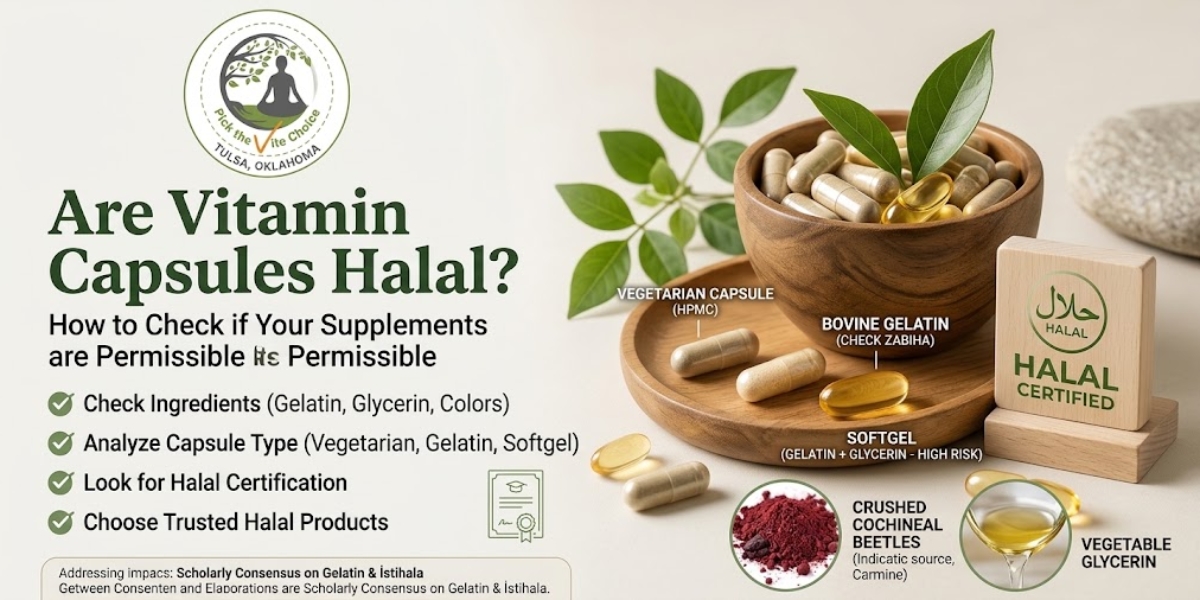
Vitamin capsules are not automatically halal, and this determination is seldom due to the vitamin component itself. Instead, concerns regarding halal compliance typically arise from the capsule shell, glycerin, colorings, and other inactive ingredients, which are often derived from pork or other impermissible sources; these origins are rarely disclosed clearly on product labels. This article clarifies the key factors affecting the halal status of vitamin capsules by examining the most relevant ingredients, explaining their sources and halal implications, and providing a systematic approach for consumers to assess supplement labels for compliance.
When asking about halal supplement capsules, most people start with the vitamins inside, but the shell that holds them together is where the most common halal concerns actually lie. Capsule shells are made from one of four materials, and each has a different default halal status.
Understanding gelatin in vitamins halal starts with knowing where gelatin comes from. Gelatin is a protein extracted from animal collagen, typically from bones, skin, or connective tissue. It is used to make both the two-piece hard capsules that twist apart and the one-piece softgel shells.
Porcine gelatin (from pig) is haram and is the industry default in most mainstream supplements. Bovine gelatin (from cow) is only permissible when the animal was slaughtered according to Islamic guidelines (zabiha) and that sourcing has been independently verified or certified. Fish gelatin is generally accepted as halal across all four major Islamic schools of thought, since fish does not require zabiha slaughter.
Important: A label that says “gelatin capsule” without specifying the source should be treated as non-halal. The pork-derived default is the industry standard, and the FDA does not require manufacturers to disclose the animal source of gelatin on supplement labels.
HPMC stands for hydroxypropyl methylcellulose, a plant-derived cellulose used to make capsule shells. You may also see it written as hypromellose on ingredient lists. On the front of a bottle, brands typically print “vegetarian capsule” or “vegetable capsule.” All three terms refer to the same material.
HPMC contains no animal derivatives. It is halal by default, as well as vegan and kosher. If you see any of these phrases on the label, the capsule shell itself is not a concern for halal vitamin capsules.
Pullulan is produced by fermenting tapioca starch. It contains no animal material and is halal by default. Pullulan capsules are less common in mainstream US products but appear in premium or oxygen-sensitive formulations, particularly for probiotics, where they offer a better moisture barrier than HPMC.
Softgels carry a double risk that most consumers miss. The shell is a one-piece gelatin film overwhelmingly porcine in conventional manufacturing. Additionally, softgels require a plasticizer to keep the shell flexible, and that plasticizer is almost always glycerin. In conventional supply chains, that glycerin is frequently derived from pork.
Any softgel without explicit halal certification, regardless of what the active ingredient is, should be assumed non-halal until confirmed otherwise.
| Capsule Format | Shell Material | Default Halal Status | What to Look For on the Label |
| Hard gelatin capsule | Animal gelatin | Verify Source | “Gelatin” alone = assume porcine. Look for “halal certified” or confirmed zabiha bovine source. |
| Softgel / soft gel | Animal gelatin + glycerin | Highest Risk | Requires explicit halal certification. “Softgel” alone is never safe to assume halal. |
| HPMC / Vegetable capsule | Plant cellulose | Halal by Default | “HPMC,” “hypromellose,” “vegetarian capsule,” or “vegetable capsule.” |
| Pullulan capsule | Tapioca fermentation | Halal by Default | “Pullulan” listed in Other Ingredients. |
| Tablet | No capsule shell | Lowest Risk | Check flow agents and coatings separately. |
Even when the capsule shell is plant-based, evaluating the capsule’s ingredient halal status doesn’t stop there. Several excipients of the inactive supporting ingredients can come from impermissible sources.
Understanding whether glycerin is halal or haram comes down entirely to its origin. Glycerin is used as a humectant in softgels, a sweetener in gummies, and a filler in some tablets. It can come from three sources:
Because labels rarely specify which type is used, look for the phrase “vegetable glycerin” explicitly stated. If it simply reads “glycerin” or “glycerol,” contact the manufacturer or choose a fully halal-certified product.
Magnesium stearate is a flow agent found in nearly every capsule and tablet, preventing ingredients from clumping during manufacturing. It is derived from stearic acid, which can come from animal fat or vegetable oil. Most supplement-grade magnesium stearate in the US is now plant-derived, but labels rarely specify. If the product carries halal certification, this has been audited. If not, ask the manufacturer directly.
Carmine, also listed as E120, cochineal, cochineal extract, natural red 4, or CI 75470, is a red pigment derived from crushed cochineal beetles. It appears in colored capsule shells, gummies, and tablets. The majority of Islamic scholars classify insects (other than locusts) as impermissible, making carmine a clearly haram ingredient. If your vitamin comes in red or pink capsules, check the label carefully.
Shellac (pharmaceutical glaze or confectioner’s glaze) is a resin secreted by lac beetles, used to coat some tablets. Its permissibility depends on your madhab; Hanafi scholars generally permit it under the principle of chemical transformation, while Shafi’i and Hanbali scholars consider insect-derived substances impure.
Most commercial vitamin D3 (cholecalciferol) is derived from lanolin, a waxy substance from sheep’s wool. The sheep is not harmed during collection, and lanolin is neither blood nor internal tissue. The majority of Islamic scholars accept lanolin-derived D3 as halal. D3 derived from fish liver oil is also halal. A third option, lichen–derived D3, is plant-based and halal without question.
The concern with D3 is rarely the D3 molecule itself; it is almost always the capsule format it’s delivered in. D3 is commonly formulated in softgels, which are the highest-risk capsule type.
Natural Flavors and Herbal Extract Solvents
“Natural flavors” on a US supplement label can include animal-derived flavor carriers that are not separately disclosed. More frequently overlooked: herbal extracts such as ashwagandha, echinacea, and valerian are sometimes processed with ethanol as a solvent, which can leave trace amounts of alcohol in the finished product. A halal-certified herbal product will specify whether it uses water-based or CO₂ extraction. If the extraction method is unstated, contact the manufacturer before purchasing.
This is one of the most common points of confusion when searching for halal vitamin capsules. A supplement labeled “100% vegan” removes all animal-derived ingredients, which eliminates porcine gelatin, carmine, and animal glycerin. That overlap is genuinely useful.
But vegan and halal are not the same standard. A vegan supplement can still contain alcohol-based herbal extracts. It can be manufactured in a facility that handles pork-derived ingredients with insufficient cross-contamination controls. Vegan certification does not audit the manufacturing process for Islamic compliance.
Practical Guidance: When no halal-certified option is available, a verified vegan supplement in a vegetable capsule is a safer starting point, but it is not a guarantee. A product carrying both vegan registration and halal certification resolves both concerns.
Most consumers trying to understand supplement capsules halal flip the bottle over and immediately feel overwhelmed. This three-step process covers the vast majority of cases.
Step 1: Check the capsule shell. Look in the “Other Ingredients” section. The words vegetarian capsule, vegetable capsule, HPMC, or hypromellose signal a plant-based shell. The word gelatin alone, without source specification, should be treated as non-halal. A softgel without halal certification is always at high risk.
Step 2: Scan for red-flag ingredients. The items below each require verification if found on a label without halal certification:
Step 3: Check for a named halal certifier. A halal logo means nothing without the certifying body named underneath it. Cross-reference the product in that certifier’s online database. Certifications expire; always check the date.
If any of the above is unclear on the label, a quick email or phone call to the manufacturer is entirely reasonable. Brands committed to halal compliance answer these questions clearly and promptly, and that responsiveness itself is a useful signal.
Third-party halal certification means an independent Islamic organization has audited ingredient sourcing, the manufacturing process, and cross-contamination controls – not just the finished label. This is meaningfully different from a brand’s self-declared “halal” claim printed on the packaging.
The three most widely recognized US halal certifiers for dietary supplements are:
Watch For This: A generic “halal” claim with no certifier named is a marketing statement, not verification. If you cannot identify who issued the certification and verify it in a public database, treat the product as uncertified.
Muslim consumers may encounter differing opinions – from scholars, pharmacists, or community members about whether gelatin from pork or non-zabiha animals is permissible. This disagreement stems from the Islamic concept of istihala (chemical transformation), which some scholars argue renders pork-derived gelatin permissible because the manufacturing process so thoroughly alters the original substance.
This is a minority position. The majority opinion across all four major Islamic schools of thought (Hanafi, Maliki, Shafi’i, and Hanbali) does not consider the transformation of pork-derived gelatin sufficient to make it halal when permissible alternatives exist.
A separate principle, darurah (necessity), permits haram ingredients in genuine medical emergencies. If a prescription medication is available only in a gelatin capsule and has no halal alternative, scholars generally allow it to be taken. For over-the-counter vitamins, where plant-based halal gelatin capsules and HPMC alternatives are widely available, the principle of necessity does not apply.
Now that you know what to look for, the easiest path is choosing supplements that have already done the work for you. Browse our full range of halal vitamins and supplements. Every product is formulated in plant-based capsules and verified halal.
Looking for a daily multivitamin? Explore our halal multivitamin capsule options, or check our guide on how to know if vitamins are halal for more buying guidance.
The capsule shell: yes, vegetarian capsules are made from HPMC (plant cellulose) and contain no animal derivatives. However, other ingredients in the formula, such as glycerin, natural flavors, magnesium stearate, and colorings, still need to be checked. The capsule being vegetarian does not guarantee the entire supplement is halal.
Most standard gummy vitamins use pork gelatin as the gelling agent and are not halal. Halal gummy vitamins use pectin, a plant-derived gelling agent instead. Look for halal certification and “pectin” listed in the ingredients rather than “gelatin.”
A softgel is a one-piece capsule used for oil-based supplements like fish oil, vitamin E, or vitamin D. The shell is made from gelatin, predominantly porcine in conventional manufacturing, and also requires glycerin as a plasticizer, which is frequently pork-derived. Softgels carry double halal risk and should not be assumed permissible without explicit halal certification.
In most cases, yes. Most commercial D3 is derived from lanolin (sheep’s wool), widely accepted as halal by the majority of Islamic scholars. Lichen-derived D3 is plant-based and halal without question. The concern is almost always the capsule format, particularly softgels, not the D3 molecule itself.
For prescription medications where no halal equivalent exists, the majority of Islamic scholars permit taking them under the principle of darurah (necessity). For over-the-counter vitamins, halal-certified and plant-capsule alternatives are widely available, so this exception generally does not apply.
Yes. Halal certificates are product-specific and typically renewed annually. A certification logo on a bottle does not mean it is always cross-referenced with the certifier’s online database. If a product has been reformulated since certification, the logo on older stock may no longer reflect the current formula.
We offer premium dietary supplements and multivitamins to support your family’s health and daily vitality.
This statement has not been evaluated by the Food and Drug Administration. This product is not intended to diagnose, treat, cure, or prevent any disease.
Use only as directed. The information provided herein is intended for informational purposes only and should not be considered as a substitute for professional medical advice. Always consult a qualified healthcare professional before starting any new dietary supplement regimen or making changes to you or your child’s existing healthcare routine. Some Medical Professionals appearing on this site may have been compensated for their opinions. Results claimed by our customers above are based on individual experiences that are unique and cannot be guaranteed